
Roofing / Restoration / Metal
Metal roof coating
Stop rust and seam leaks on ribbed and standing-seam metal roofs with a coating system that seals fasteners and laps. Spray foam is available as an alternative.
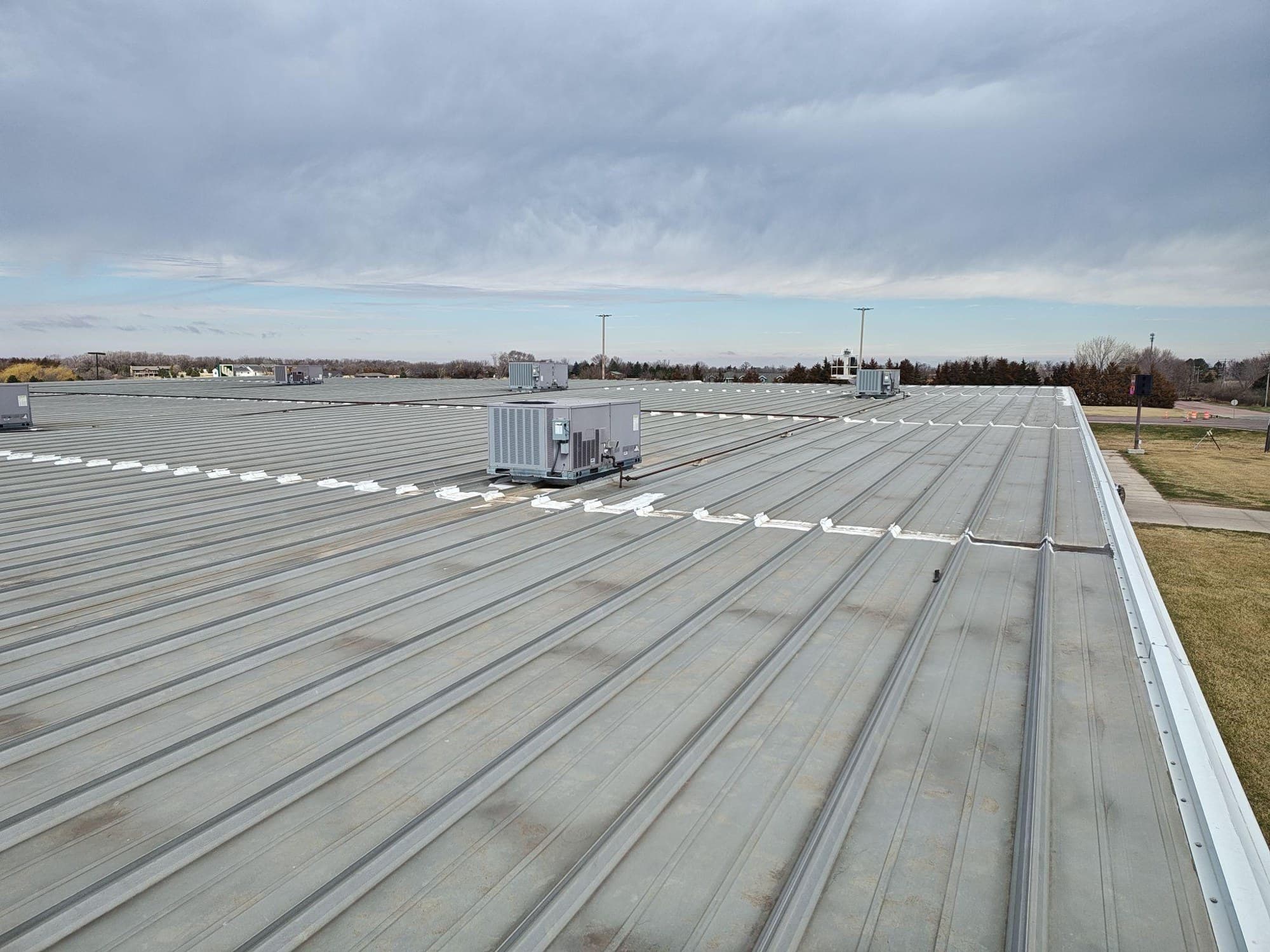
- Primary method
- Coating
- Alternative
- SPF
What goes wrong, and where
Metal roofs leak where they move: at lapped seams, around thousands of fasteners, and along rusting panel edges. A coating system seals the entire roof as one continuous membrane, locking down seams and fastener heads and stopping corrosion, while keeping the panels in place. Where added insulation or a fully monolithic surface is the goal, spray foam over the metal is the alternative, though coating is usually the better-returning call.
Seams and laps
Lapped panels expand and contract daily. A coating bridges and reinforces the laps so they stop working water through the joint.
Thousands of fasteners
Every exposed fastener is a potential leak as gaskets age. The coating seals fastener heads across the whole roof in one pass.
Rust arrested
After cleaning and priming bare or rusting metal, the coating encapsulates the panel and stops further corrosion.
Coating vs spray foam
Coating is usually the higher-return choice on metal: lower cost, fast application, fully renewable. SPF is the alternative when added R-value or a fully monolithic surface is the priority.
The method that fits
Coating (SPF alternative)
A coating seals seams, fastener heads, and rust across the whole roof in one continuous membrane. Spray foam is the alternative when added insulation is the goal.
High
Restoration keeps the deck and insulation in place, so the spend goes to the membrane that fails, not to a tear-off and a full rebuild.
Restoration on this roof
- 01
Survey
We check panels for rust, loose fasteners, and failed seams, and confirm the deck below is sound.
- 02
Clean & treat
The roof is cleaned, rust is treated and primed, and loose fasteners are reset.
- 03
Detail seams
Lapped seams and fastener heads are reinforced so the coating bridges every joint.
- 04
Coat
The topcoat is applied at warranty thickness, sealing the roof and arresting corrosion for a 10, 15, or 20-year term.
Single-ply vs. metal vs. built-up
The three commercial substrates fail differently, and the right renewal path differs too: coating for single-ply and metal, spray foam conversion for built-up. All three renew in place without a tear-off. Here is how they compare.
| Attribute | Single-ply (TPO / EPDM / PVC) | Metal panel | Built-up (BUR) |
|---|---|---|---|
| First failure point | Seams and laps | Seams, fasteners, rust | Flood coat, ply separation |
| How water gets in | Open seams, shrinkage stress at flashings | Lap joints and aging fastener gaskets | Cracked flood coat, water tracking between plies |
| Renewal method | Fluid-applied coating | Coating (SPF alternative) | Spray foam conversion |
| Adds insulation | No | Only with the SPF option | Yes, ~R-6.5 / in |
| Tear-off required | No | No | Rarely |
| Restored warranty | 10 / 15 / 20 yr | 10 / 15 / 20 yr | 10 / 15 / 20 yr |
| Ruled out when | Wet insulation or failed adhesion | Structural rust-through in panels | Widespread trapped moisture |
Typical industry figures for comparison. Actual condition and restorability are confirmed by moisture survey during the assessment.
Different roof, same approach
- TPO, EPDM, PVCSingle-ply restoration
- Smooth & gravel BURBuilt-up restoration
- All substratesRestoration overview
All restoration work is self-performed by A-1 with 10, 15, and 20-year warranties.
Metal restoration questions
Can you coat ribbed and standing-seam metal?
Yes. Both profiles are coated once the roof is cleaned, rust is treated, and seams and fasteners are detailed. The finished coating is continuous across the panels.
Coating or spray foam on metal?
Coating is usually the higher-ROI choice on metal: it seals seams and fasteners at lower cost and is fully renewable. Spray foam is the alternative when you want added insulation or a fully monolithic surface.
What about rust?
Bare and rusting metal is cleaned and primed before coating, which arrests corrosion. Severely deteriorated panels are repaired or replaced first.
Will it stop the fastener leaks?
Yes. Exposed fasteners are a common leak source as gaskets fail. The coating seals every fastener head and the surrounding panel in one continuous membrane.
How is the metal roof prepared?
The roof is cleaned, rust is treated and primed, loose fasteners are reset, and seams and penetrations are reinforced before the topcoat goes on.
How long does a coated metal roof last?
Warranty term follows the dry film thickness applied: roughly 10, 15, or 20 years, and the roof is renewable on a recoat cycle.
Stop the rust and seam leaks on your metal roof
A coating seals seams and fasteners and arrests corrosion without a tear-off. We confirm the right system after the assessment.
41-year commercial roofing and insulation record