
In short
A metal roof leaking at every screw has two prime suspects. Either the rubber washers have failed across the roof, or warm, wet air inside is condensing on the cold steel and running to the screws, the lowest points it can drip from. Rule out condensation first. Then the panel condition picks the fix: re-screw if the panels are sound, seal and coat if they are sound but rusting, replace any panels that are rusted through, and re-skin if most of them are. Below 2:12, ask the coating manufacturer before anyone quotes a coating.
What you need before you start
You do not need a contractor for the first step. Steps 2 and 3 mean walking the roof; if you are not set up for fall protection on metal, have a roofer do them. You need a few things on hand.
- A drip log: date, time, and whether it rained in the 24 hours before. Keep it through at least one rain and one cold, clear night.
- A look at the underside of the roof deck from inside, with a flashlight, during or right after a drip.
- The roof's age, and whether the screws go through the panel face (exposed fastener) or the panels lock together at raised seams with only trim and flashings screwed down (standing seam).
- The slope. Gaco's metal roof specification says the panels should have a slope of 2:12 or greater to promote positive drainage.
- What the building is used for. A cold storage room or freezer building changes the answer, as "Where this fails" explains.
Step 1: Prove it is a leak and not condensation
Condensation is the false alarm to rule out first, because no screw, sealant or thin coating fixes it. The test is timing. A leak follows rain or snowmelt. Condensation follows cold nights, and it can drip on a dry, clear morning.
Wick Buildings' Adam Kraus starts from two facts: warm air holds more moisture than cold air, and warm air rises. Wick's article explains the rest. At night the roof is colder than the air inside the building. The warm, wet air meets the cold panel, cools, and drops its water on the underside. From there, gravity takes over: the drops run along the steel and fall from whatever sticks down.
Contractors call this sweating. In a 2010 ContractorTalk thread titled "metal roof leaking at every screw," the original poster had replaced the old #9 screws on a pole barn garage with #14 neoprene-washer screws and still found the insulation wet where each screw touched it, and said it still leaked when it rained. The replies split two ways: one contractor asked whether the new washers were over-tightened, another whether the building was heated and the insulation touched the metal. Another reply described metal pole barns without foam under the roofing or good ventilation that look like they leak "when really it's condensing and dripping off the screw points." Both causes can be true at once.
- Drips on days with no rain in the log: condensation.
- Wet, beaded underside across whole panels as well as at screws: condensation.
- Drips on a sunny or thawing day after a cold snap, with frost or ice on the underside: melting condensation, even if snow is melting outside at the same time.
- Drips only during or after rain: leak.
- Both: you have two problems. Fix the leak, then deal with the moisture inside.
How does A-1 trace a leak to where it gets in?
Once the log says leak, A-1 finds the drip points inside the building and measures each one from two fixed references, which gives a rough idea of where the water gets in. Then the crew inspects the roof side directly above that area for anything suspicious. Metal roofs make this harder than it sounds: water can run along the steel in several directions before it falls off the framing to the floor.
For an immediate leak repair, A-1 seals the entry point with urethane caulk, or with silicone caulk if the roof is already coated with silicone.
A-1 often asks the owner for photos before going out, to judge how complex the problem is. Kent's verdict: "Sometimes it helps and other times it doesn't."
Step 2: Check the screws
If the log says leak, go to the screws. Roofing screws seal with a rubber washer under the head, and SFS, a fastening-systems supplier, lists three ways that seal fails from the day it goes in: driven too deep, the washer is crushed and bulges out the sides; driven at an angle, it never seals all the way around; under-driven, it never seats.
Age does the rest. SFS's guidance is that once roof screws pass 20 years old, assume they are on borrowed time, and that most will not safely make it past 30. A roof where every screw leaks after 20-plus years fits that pattern: the washers were installed together, so they aged out together. Check that each screw actually hit the purlin, too: a screw shank visible from inside beside the purlin means it missed, and the washer has nothing to clamp against.
Loose screws that spin in their holes cannot be fixed by tightening. The hole is wallowed out. The fix is an oversize screw: SFS's example replaces a #14 self-tapping screw with a #17. Gaco's coating specification says the same thing in its own words: retighten where possible, and where fasteners are stripped, missing, corroded, or the neoprene grommets are deteriorated, replace them with oversize screws.
When a hole will not hold even the oversize screw, A-1 moves the screw as close to the old position as it can and fills the old hole with reinforced sealant.
Step 3: Check the panels and the laps
Screws are not the only leak points. Panel laps leak, and so do flashings, penetrations, curbs and the closure strips at the eave. At Was Ake' the inspection also found cracked sealant under the edge flashing and at penetrations. Gaco's specification calls for inspecting the horizontal and vertical seams and panel end laps, and where they have failed, removing the fasteners, cleaning out the old sealant, adding new butyl caulk, and re-fastening to rebuild the compression seal.
Then look at the steel itself. Surface rust you can wire-brush off is a coating job. Panels with rust holes you can see daylight through, or that sag between purlins, have to come out: Gaco's specification requires panels that are intact and free of deflection. Dents that hold water are a question for the manufacturer. Gaco's specification is written for panels in sound condition, free of deflection, and says severe oxidation may leave some panels unfit to coat, which should be replaced as needed. If only some panels are that far gone, replace those and coat the rest. If most are, price a re-skin against the coating.
What this looked like on a 1994 roof in Wagner, SD
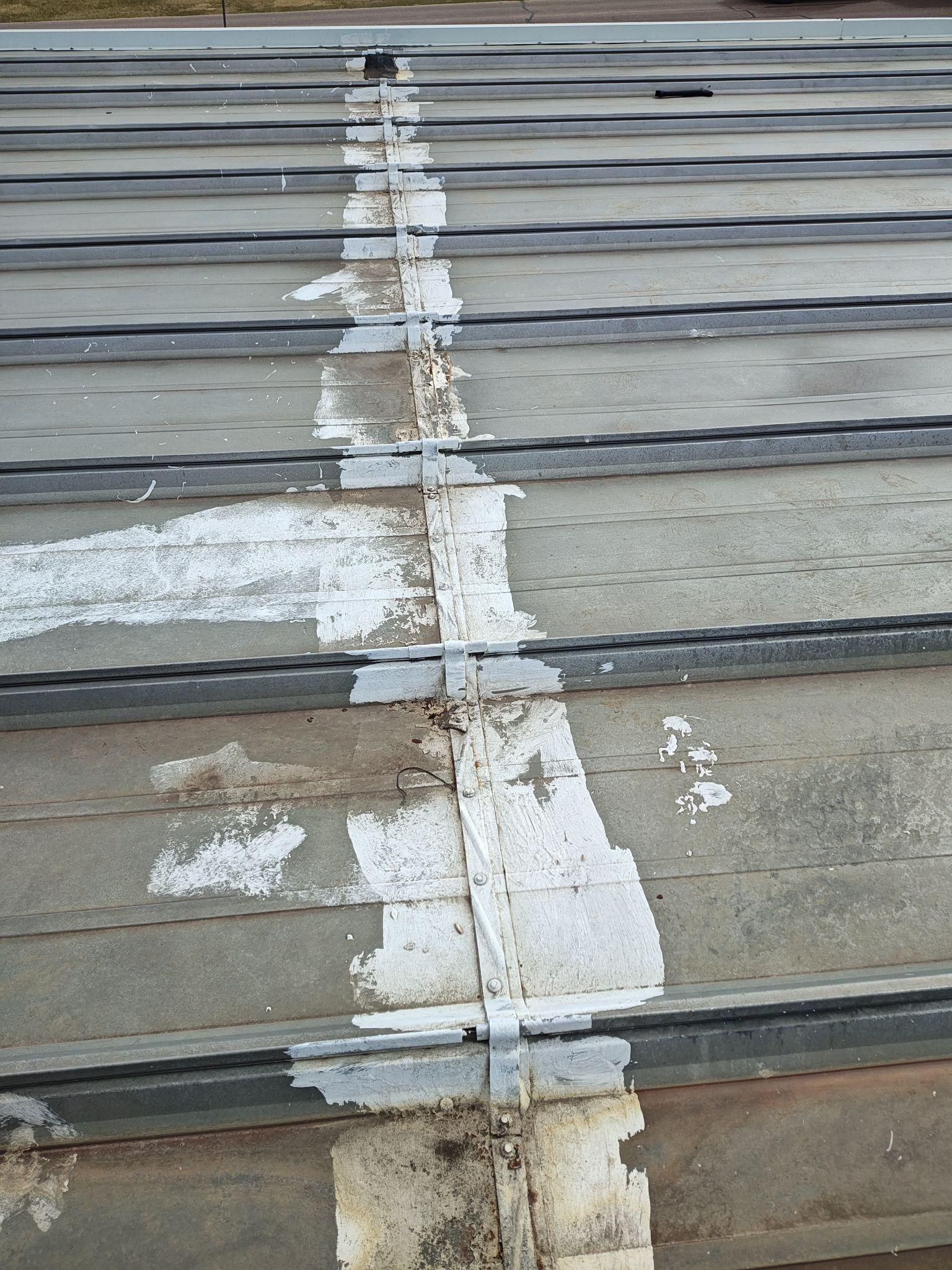
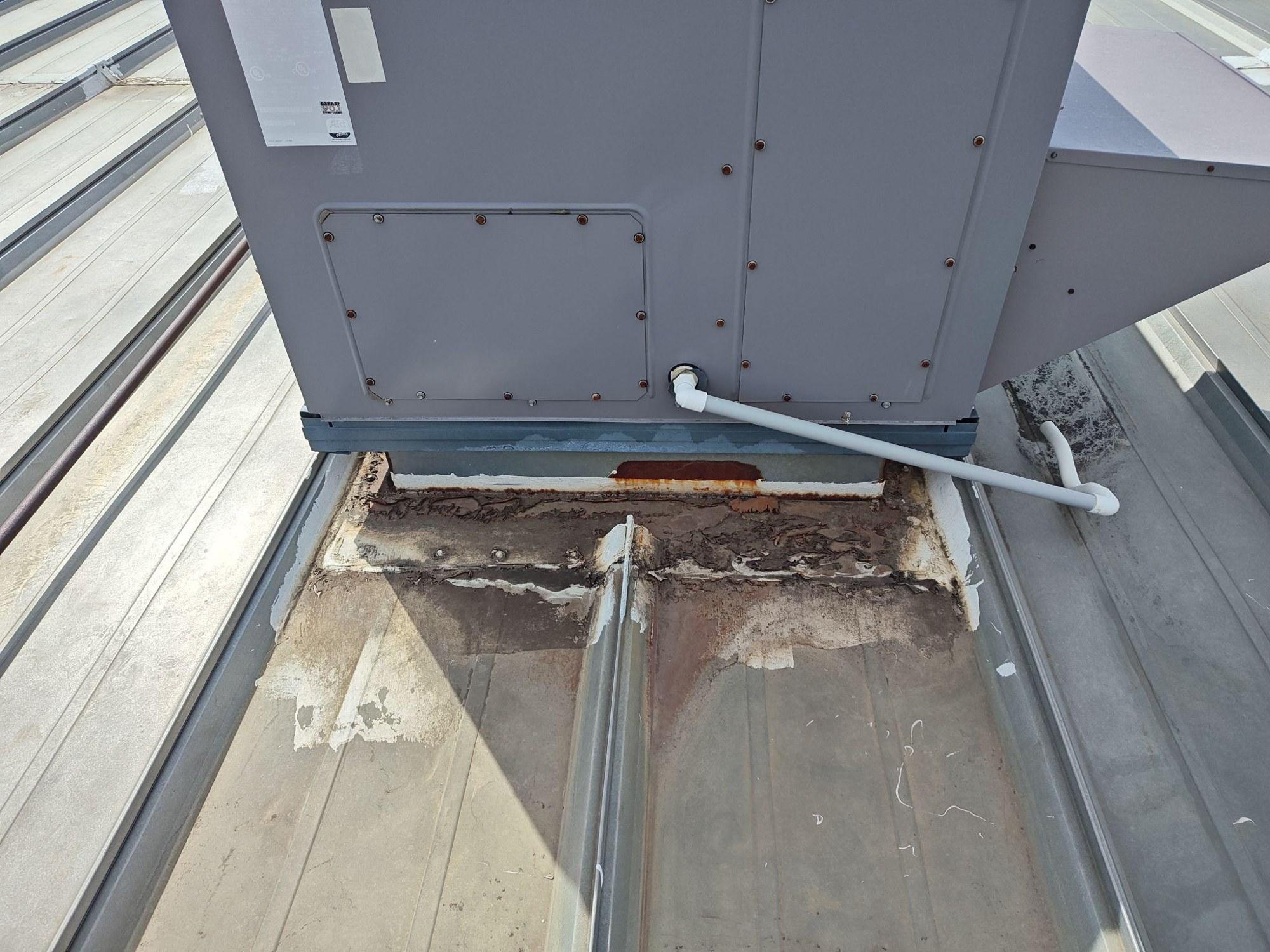
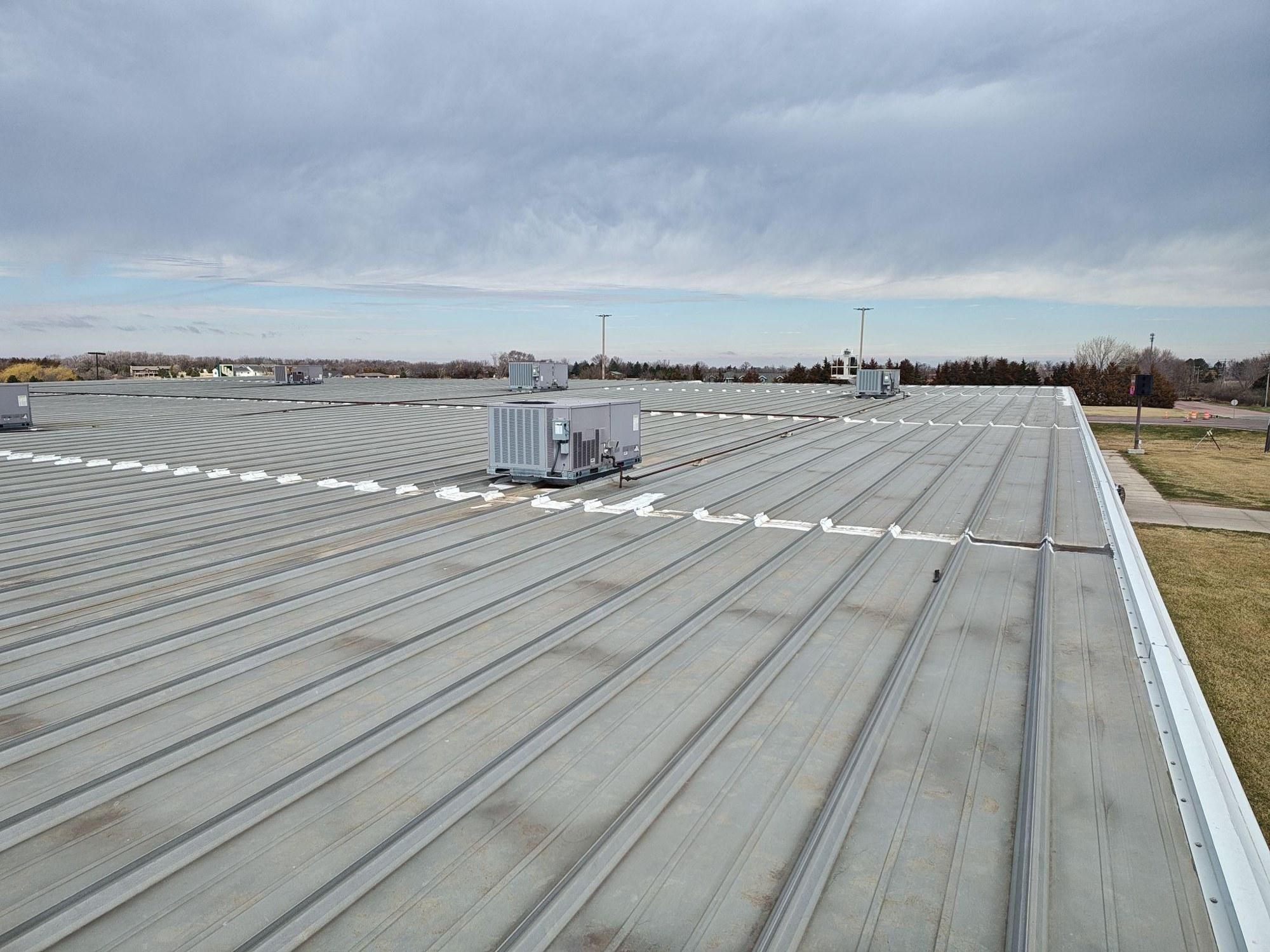
A-1 inspected the Was Ake’ Building in Wagner on March 30, 2026. It is a 22,960 square foot office and conference building with a 1994 standing seam roof. It was leaking, with stained ceiling tile below. Earlier repairs at the seams were coming apart. Fasteners were loose or missing at the gutter edge, the seam overlaps and the edge flashings. Rust ranged from minimal to moderately severe. Our inspector graded the fasteners D, with missing screws and dried seals, but the structure B: stable except where the rust was severe. Failed seals on sound steel is the roof Gaco's metal specification is written for. We graded the roof D+ with under two years of life left.
It was not leaking at every screw. Kent Sybesma, A-1's Director of Operations, says age and movement of the panels were making leaks more frequent, and they came from several sources: loose or missing fasteners, dried fastener washers, aged end-lap sealants, panels rusting where the factory Galvalume finish had thinned, and cracked detail sealants.
Standing seam is not the typical screw-down roof this post is about: its panels lock together at raised seams instead of being screwed through the face. But it was leaking through failed seams, rust and loose fasteners, the same kinds of points this post covers, so the repair worked through the same points. The laps were reinforced with urethane products, which Kent chose for their flexibility and tensile strength.
- Mechanically removed the rust.
- Replaced the loose and missing screws at the gutter edge, seam overlaps and edge flashings.
- Primed the rusted areas with a rust-inhibiting primer.
- Sealed every seam, bolt and penetration with a flashing-grade product.
- Top-coated the whole roof into one seamless silicone membrane.
What the Was Ake’ job proves, and what it does not
The job took 10 working days with no tear-off, and the roof now carries a 20-year no-dollar-limit labor and material warranty from Gaco, issued under specification MR-S20-38-20. That specification's minimum is 38 mils dry film thickness of silicone over the field, 2.5 gallons per 100 square feet, with Gaco recommending a 10 percent variance factor on top to meet that minimum. Those numbers are the specification's requirement. We have not published thickness readings from this roof.
What it does not prove: that every leaking metal roof is a coating candidate. Was Ake’ was installed to MR-S20-38-20, a specification written for panels in sound condition, and Gaco issued its 20-year warranty on the finished roof. Gaco inspected the roof before the work, as it does on every project it warrants.
Step 4: Choose the fix
Once you know it is a leak and you know what the panels look like, the choice mostly makes itself. Here is how we sort it.
- Re-screw only: panels sound, little or no rust, laps holding, leaks only at fasteners. Replace every failed screw with an oversize one and do not over-drive it. This is the cheapest fix, and it leaves the aging finish and the original laps in place.
- Seal and coat: panels sound but rusting (replace any rusted-through panels first), or screws and laps both failing across the roof, on a slope of 2:12 or more. Replace the bad screws, rebuild the laps, prime the rust, seal each fastener, then coat the whole surface. This replaces the failure points with one continuous membrane, and it can carry a manufacturer warranty once the manufacturer approves the roof.
- Re-skin: most panels rusted through or sagging. New panels and new screws. A coating cannot replace steel that has rusted away.
- Under 2:12: below the slope this Gaco metal specification recommends. Ask the coating manufacturer which specification covers a low-slope metal roof, or re-roof with a panel rated for that slope.
- If Step 1 found condensation too: screws and a coating will not fix it, because a thin coating does not insulate the steel. Insulation does, either inside (with a vapor retarder and humidity control) or as spray foam over the outside of the panels. At Freeman Shopping Center in Freeman, SD, a 43-year-old metal panel roof leaked at its fasteners and seams and also condensed on the underside after cold snaps. In 2021 A-1 sprayed high-density foam and an acrylic coating over the existing metal in ten working days, with no tear-off. The foam added R-10 at the outer surface, which moved the condensing surface outside the building and ended the ceiling-tile staining along with the leaks.
Step 5: Run the per-year math
The sticker price misleads on its own, so put each fix on a per-year basis: the installed price per square foot divided by the years it is meant to last. For a coating, use the warranty term in writing. It is not a lifespan, but it is the only period anyone has committed to. For new panels, SFS projects 40 to 70 years for a metal roof. The same SFS page says exposed screws are on borrowed time after 20 years, so a screw-down re-skin will need its fasteners redone inside that span.
Re-skinning costs the most up front. FBi Buildings' June 2023 figures for re-skinning a screw-fastened 40 by 60 foot pole barn (FBi does not say whether they cover the roof, the walls or both, and its attach rate is worded for siding) were minimums of $1.50 per square foot to remove the old steel, $1.25 to attach the new steel siding, and $3.00 for the new panels. That adds up to at least $5.75 per square foot before trim, freight, dumpsters, screws or engineering (legacy benchmark, June 2023). It is a post-frame building figure; a commercial roof re-skin is priced on its own scope.
A silicone coating restoration runs $2.50 to $4.50 per square foot installed, applied at 20 to 30 mils, per Commercial Roof Guide's March 2026 industry estimate. That range covers commercial roofs in general and does not break out metal prep such as screw replacement and lap work. A 20-year Gaco metal system calls for 38 mils dry, thicker than the range assumes, so the range tops out below the thickness a 20-year metal system needs, and may understate it.
Run the division on the bids you actually get. A coating's per-year figure holds only for its warranty term, and a re-skin spreads its higher price over a longer life, so the two can land closer than the sticker prices suggest.
Re-screwing has no reliable published per-square-foot figure. It is the cheapest of the three to start, and it leaves the clock running on everything it does not touch: the laps, the finish, and the rust.
These are third-party industry estimates. A-1 prices each roof after an inspection. Ask every bidder for the warranty term and the specification number in writing, then divide.
Where this fails
Every one of these has a next move.
- New screws, same drips. The log was probably catching condensation. Check the underside on a dry, cold morning. If it is wet, the fix is insulation: inside the building, or spray foam over the outside of the panels. RIMA International, a reflective insulation trade association, calls a vapor retarder on the underside of a metal roof deck highly recommended and names inside relative humidity under 60 percent as an important factor in preventing condensation.
- New screws still leak. The usual causes are an over-driven screw, a screw that missed the purlin, or a hole too wallowed out even for the oversize screw. Pull one and look at the washer. If it is crushed, replace that screw and drive the new one straight, only until the washer seats without bulging out the sides. If a hole will not hold even an oversize screw, have the roofer re-secure the panel with a new fastener into sound framing, as Gaco's specification requires before coating. Coating over a screw that no longer holds leaves the panel loose under the coating.
- The leak is at a lap. Re-screwing will not touch it. The lap has to be opened, cleaned and re-sealed with butyl, which is the step Gaco's specification calls for before any coating.
- The roof is cold storage. Gaco's specification says its silicone is not recommended for cold storage or cryogenic buildings with constant high water vapor drive. Ask for a different system, or re-skin.
- The contractor will not name a specification. Without a spec number there is no way to check the thickness or the warranty. Ask for the spec number in writing or get another bid.
- The panels are under 2:12. That is below the slope this Gaco specification recommends. Ask the manufacturer whether another specification covers the roof before anyone quotes a coating, or re-roof with a panel rated for that slope.
How you know it worked
The ceiling stays dry through the next heavy rain and the next spring thaw, and the drip log stays empty on dry days too. For a coating, you also hold a warranty document that names the specification and its term. Before work starts, ask the contractor to record wet film gauge readings as the coating goes on and to give you a copy.
Next step
If your log says leak and your panels are rusted but still solid, that is the roof we restored in Wagner: 22,960 square feet, 10 working days, no tear-off, 20-year warranty. Send us photos of the underside and the worst screws, and we will tell you which fix looks likely and what an on-roof inspection needs to confirm.
Costs in this post are third-party industry estimates and a 2023 legacy benchmark. A-1 quotes each roof separately, and actual pricing depends on roof size, condition, access and the warranty term specified. Warranty terms are set by the coating manufacturer and require its approval of the specific roof.
Questions owners ask next
- Can a new metal roof be coated?
- It depends on the surface. Gaco's metal roof specification lists steel aged at least one year or treated galvanized steel, anodized aluminum, and pre-finished metal other than siliconized polyester (SMP) and fluorocarbon (PVDF, often sold as Kynar 500) finishes. Ask the panel maker or check the original paint warranty to find out which you have. Bare steel under a year old, or a roof with one of those two finishes, needs the manufacturer's answer before anyone quotes a coating.
- Is a metal roof coating sprayed or rolled on?
- Both, depending on the step. Gaco's specification has the mesh-reinforced seam coat brushed or rolled, allows brush, roller or spray for the primer, and its site rules for overspray, including signs posted within 400 feet, assume spraying. Thickness matters more than method: the specification also requires an extra pass at edges, penetrations and standing seams.
- Is a silicone-coated metal roof slippery?
- It can be, especially wet. Gaco's specification offers an optional granular coat: a light extra coat of silicone with white roofing granules broadcast into it at 30 pounds per 100 square feet. The specification still warns that walking on a coated roof calls for caution, particularly in wet conditions.
Related on this site
- Metal roof coating
- Commercial roof repair
- The silicone recoat cycle explained
- The SPF roof inspection checklist
- Commercial roof hail claims in five states
- Case study: Was Ake' Building metal roof restoration
- Case study: Freeman Shopping Center spray foam over metal
- Spray polyurethane foam roofing
- Commercial roofing in South Dakota
- Commercial roofing in Yankton
Sources
- Gaco, GacoFlex S20 Series over Metal Roof, specification MR-S20-38-20 (revised May 2026)
- SFS, How to replace metal roof screws
- Wick Buildings, How to prevent condensation under a metal roof (published July 2017, updated February 2025)
- ContractorTalk, Metal roof leaking at every screw (forum thread, 2010)
- RIMA International, Condensation FAQ
- FBi Buildings, How much does it cost to reskin a 40' x 60' pole barn? (June 22, 2023)
- Commercial Roof Guide, Commercial roof cost (updated March 2026)